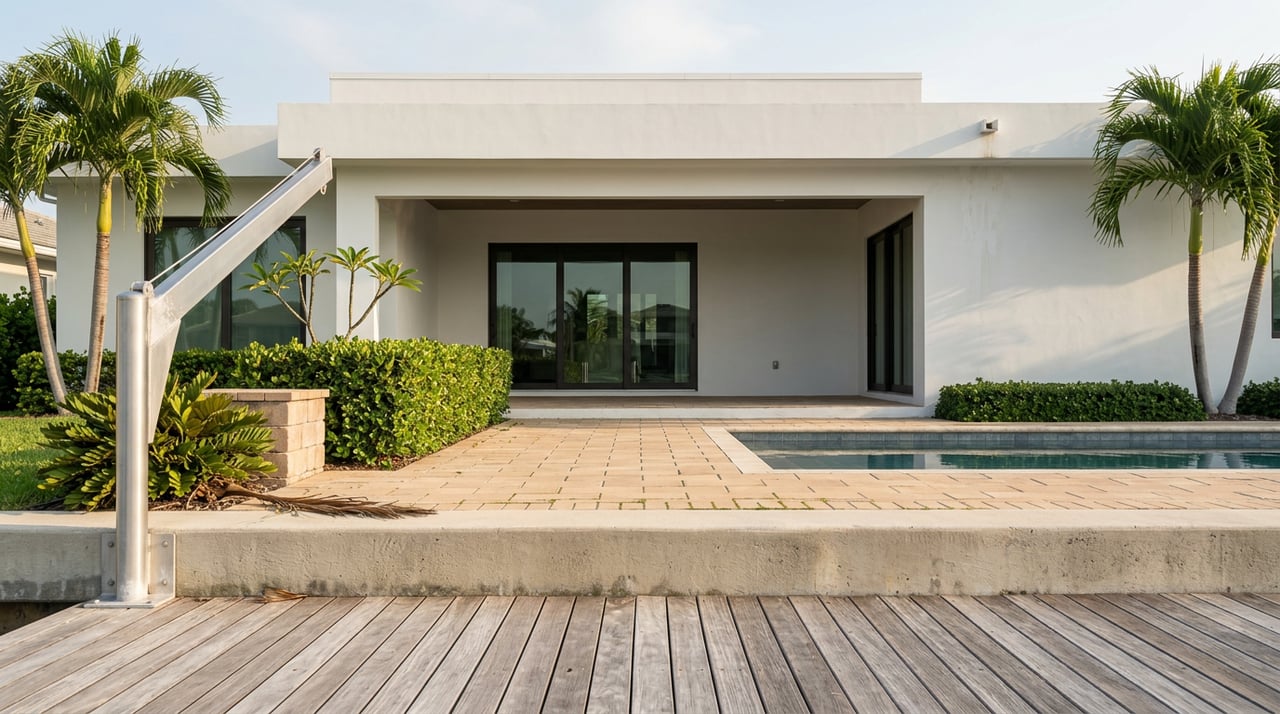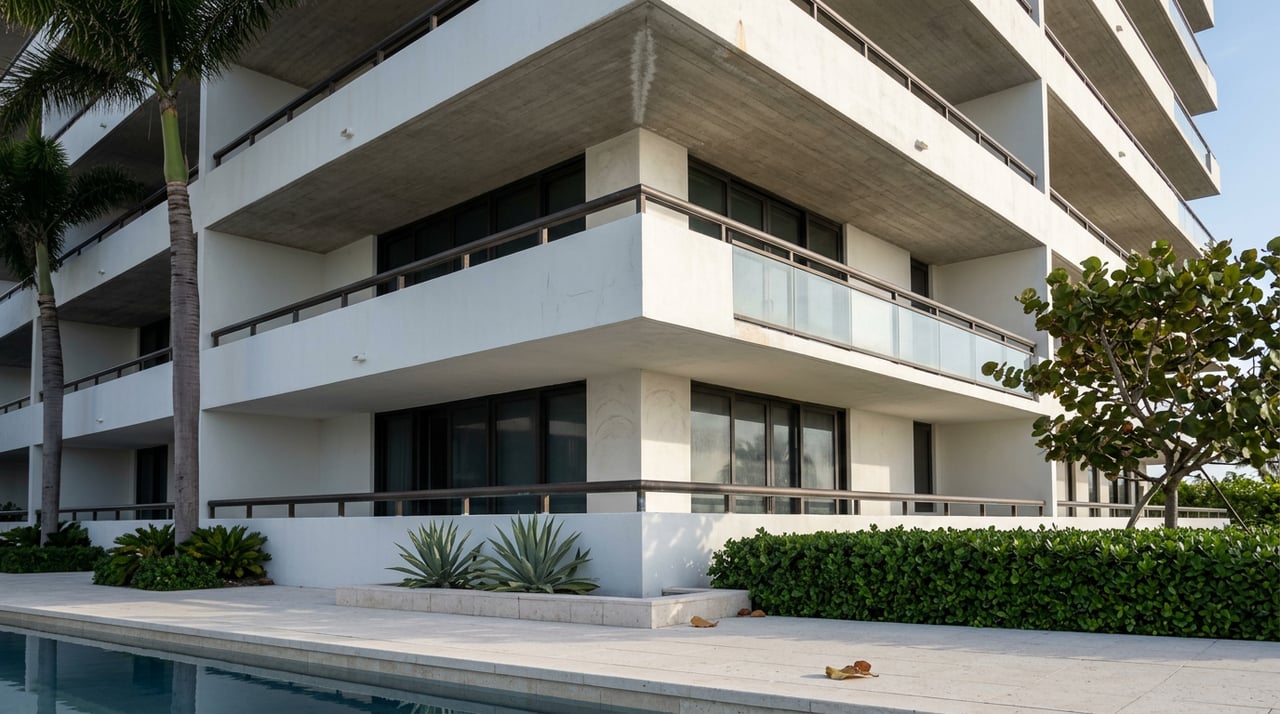
Two oceanfront towers stand within walking distance of each other on North Ocean Drive. Both face the same water. Both offer the same sunrise from the same elevation. One trades near $600 per square foot and the other clears $900. The brochures will tell you the difference is finishes, service, and amenity programming. The transaction file tells you something else: the certificate of occupancy date, and what that date now obligates the association to do.
On a four-mile barrier island where nearly all inventory is vertical, the variable that moves price hardest is not the view. It is the building's structural compliance and reserve posture under Florida's post-Surfside framework. That single fact reorganizes how a serious buyer should read every listing on the island, and it is almost entirely invisible from the outside.
First, find out who holds the file
Here is the friction that catches capable buyers off guard, and it surfaces in week one of due diligence rather than at the closing table.
Florida's milestone inspection law, Statute 553.899, requires a structural inspection of condominium and cooperative buildings three or more habitable stories tall, with repeat inspections every ten years. The statewide trigger is 30 years from the certificate of occupancy. A 25-year trigger applies for coastal buildings where the local enforcement agency has determined that local conditions warrant it, a change made when the legislature converted the original automatic coastal rule into a local option.
That word "local" is doing a great deal of work. Palm Beach County's Building Division states a first inspection at 25 years for buildings within three miles of a coastline and 30 years for those farther inland, with noncompliance exposing an association to fines of $500 or more per day, referral to Code Compliance, a special magistrate hearing, and a report to the state's Division of Condominiums. Singer Island, though, sits inside the City of Riviera Beach, which operates its own Building Services Division. The county's published threshold governs the jurisdictions the county enforces. For a specific tower on Ocean Drive or Lake Drive, the operative deadline comes from the city's building official.
Buyers who assume the county page answers the question for their building are answering a different building's question. Ask which agency holds the file before you ask anything else about it.
What the island median actually averages
Once you know the trigger, the pricing pattern stops looking random.
As of late March 2026, active Singer Island condominium listings spanned roughly $249,000 to just under $9 million, with a median list price near $897,000 and about $793 per square foot. A separate March 2026 summary of the same market put the median list at $925,000 and closer to $626 per square foot, with a 92 percent sale-to-list ratio and a median 106 days on market. Both are defensible. Neither describes a product a buyer can actually purchase, because the island's inventory is two cohorts wearing one median.
| Cohort | Representative buildings | What the price per foot reflects |
|---|---|---|
| Pre-1990 towers | Cote D'Azur I, completed 1974, 18 stories, 204 units; Corniche, completed 1982, 22 stories, 110 units; Sea Winds, completed 1984, 24 stories, 182 units | View and location, less the market's estimate of remaining structural and reserve obligation |
| 2004 and newer | Oasis, completed 2004; Ritz-Carlton Residences at 2700 North Ocean Drive, completed 2008, 242 units; Water Club; VistaBlue; Amrit Ocean Resort and Residences | View, location, service, and a compliance clock that has not started |
The spread is measurable. Across the year ending March 2026, resales at the Ritz-Carlton Residences averaged roughly $937 per square foot, moved in about 73 days, and closed near 94 percent of list. Against an island-wide figure in the $600s, that is not a finish-level premium. It is the market pricing certainty.
A buyer anchoring to the island median will be repriced the moment they walk into a post-2004 building. A buyer anchoring to Ritz pricing will misread what an older tower's discount is compensating for. Both errors come from the same source: treating a blended median as a comparable.
The county numbers point the other way, which is the tell
Palm Beach County's broader condominium market is soft. Data from the MIAMI Association of Realtors and the Southeast Florida MLS, as of July 17, 2026, put the county condo and townhome median at $325,000 with 7.2 months of supply and 68 days to contract. The single-family segment in the same snapshot showed a $700,000 median, 3.9 months of supply, and 42 days to contract. The gap has a documented cause: special assessments tied to building safety requirements, combined with rising association dues and condominium insurance costs, have pushed buyers who once shopped condos into houses or out of the search entirely.
Singer Island runs against that current. A Q2 2026 read of the Riviera Beach market showed the island at roughly 4.2 months of supply versus a county average near 6.38 months, with median condominium prices up about 7.8 percent year over year.
Read those two facts together and the thesis sharpens. The island is outperforming the county condominium trend, but the outperformance is concentrated in the segment where the compliance question has already been answered. Ocean frontage is not what separates a tight submarket from a soft one right now. A closed file is.
The monthly fee stopped being a signal
The instinct to read a low monthly assessment as evidence of a well-run building is now unreliable, and the reason is specific.
House Bill 913, effective July 1, 2025, raised the threshold for items requiring mandatory reserve funding from $10,000 to $25,000 and indexed it to inflation, with the Department of Business and Professional Regulation setting the 2026 figure at $25,675. The same law lets boards fund reserves through loans or lines of credit, and allows a temporary pause on reserve contributions for up to two consecutive budget years after a milestone inspection identifies repairs. That pause requires approval by a majority of the association's total voting interests, a higher bar than a meeting-quorum vote, and the study must be updated before regular funding resumes. HB 913 also requires any engineer or architect performing a reserve study or milestone inspection to disclose in writing an intent to bid the resulting repair work, and requires structural reports to be retained for fifteen years.
Meanwhile the reserve side has hardened. Under DBPR's current guidance, unit-owner-controlled associations existing on or before July 1, 2022 were to complete a Structural Integrity Reserve Study by December 31, 2025, with a narrow allowance to complete it alongside a milestone inspection due on or before December 31, 2026 and never later. Waivers of reserves for the study's named structural components are no longer permitted, and associations that had previously waived were to begin funding as of January 1, 2026.
So a flat fee in 2026 may reflect a healthy reserve schedule. It may also reflect a pause vote, a credit line, or a line item reclassified under the higher threshold. The fee and the funding schedule have to be read as one document.
Which is why the due diligence list looks like this:
- The Phase 1 milestone report, and any Phase 2 report. Associations must distribute the inspector's summary to unit owners within 45 days of receipt and post it conspicuously, with the full report published to the association website where one is required.
- The Structural Integrity Reserve Study and its recommended annual funding schedule, not merely confirmation that a study exists.
- Any owner vote under HB 913 authorizing a reserve pause, a line of credit, or pooled reserves.
- Twelve months of board minutes, read for pending assessment votes and repair procurement.
- The purchase contract's assessment-allocation clause. Under most Florida condominium contracts an assessment levied before the contract date sits with the seller and one levied after the effective date sits with the buyer.
- Written confirmation from the city's building official of the inspection trigger and status for that specific address.
None of the above is legal or financial advice. It is the sequence in which the questions get answerable.
The state's own file cannot settle it
In July 2026 Florida's Office of Program Policy Analysis and Government Accountability published Report 26-04, the first statewide accounting of milestone inspection reporting. Building officials reported 8,736 completed Phase 1 inspections and 1,575 completed Phase 2 inspections across 2024 and 2025, along with 1,587 extensions granted for initial deadlines, 94 percent of them in coastal counties. Inspections identified 30 buildings in 2024 and 24 in 2025 as unsafe or uninhabitable, and most were not vacated. Repair permits tied to Phase 2 findings averaged $337,229 in 2024 and $496,236 in 2025, with concrete, electrical, and structural work most common and nearly all of those permits filed in coastal jurisdictions.
The reporting gap matters more than the totals. DBPR received data from 277 of 389 local enforcement jurisdictions in 2024 and 250 in 2025, response rates of 71 and 64 percent. Coverage of the report identified Palm Beach County as South Florida's weakest reporter, with 44 percent of building officials not submitting 2025 data.
For a buyer, that is the practical conclusion of the whole exercise. There is no public dataset that reliably answers whether a particular Singer Island tower has completed its inspection cycle, what it found, or how the board intends to pay for what it found. The information exists, and it exists in one place: the association's own records.
The land under the tower belongs in the math
One more element separates Singer Island from weaker coastal submarkets carrying the same building ages.
In February 2026 The Continuum Co. filed site plans with Riviera Beach for Singer Island Gateway at 2525 Lake Drive, an Arquitectonica-designed project of 298 residences with a restaurant, stores, a marina, and a 25,000-square-foot public open space along Blue Heron Boulevard, positioned to pull the building away from the Phil Foster Park dive site. As Stet News reported through the spring and summer, the proposal drew sustained resident opposition over scale, traffic, and shadow, and it still requires approval from the Planning and Zoning Board, the Community Redevelopment Agency, and the City Council. The city has separately moved to fund its own dune placement on the island's northern end after the county declined to add sand, and paid parking resumed in August 2026 with a $50 annual resident permit.
Take the development interest for what it is: evidence of what the underlying land commands. Where land carries that value, an aging tower facing a large repair program has options that an identical building on less desirable ground does not. That is why the older-tower discount on Singer Island behaves differently than the same discount elsewhere on the coast, and why the discount deserves analysis rather than reflex.
Questions this raises
Does a completed milestone inspection mean the building is finished with the issue?
No. Completion means the inspection happened. If a Phase 2 report identifies deterioration, repairs must commence within 365 days of receipt, and the funding decision follows separately. Confirming an inspection occurred is the beginning of the question.
Is a newer building automatically the safer purchase?
Not automatically. A newer building carries no near-term inspection obligation, which the market prices in. It also carries its own fee structure, service model, and reserve schedule. The comparison worth making is total carrying cost against how the residence will actually be used.
If a tower is facing a large assessment, is that always a reason to walk?
It is a reason to price it. An assessment with a defined scope, an engineer's report behind it, and a board funding plan is a known quantity. An unfunded reserve schedule with no study distributed is not.
Singer Island rewards buyers and sellers who read the file before they read the finishes. If you are weighing a sale in a market where two identical views can carry two different values, or evaluating a purchase where the decisive facts live in association records rather than a listing, The Hyland Group brings decades of Palm Beaches experience and Corcoran's marketing reach to that analysis, with the discretion the decision deserves.
Request a Confidential Home Valuation.